Manson Family Member Speaks Out About Life Inside the Cult
/https://tf-cmsv2-smithsonianmag-media.s3.amazonaws.com/filer/81/d2/81d25598-d4aa-4171-a868-4dfa220375b7/gettyimages-515288632.jpg)
In Once Upon a Time ... in Hollywood, the new film from director Quentin Tarantino, an actor and stuntman (played by Leonardo DiCaprio and Brad Pitt, respectively) find themselves living next door to beautiful actress Sharon Tate (Margot Robbie). It'due south the summer of 1969, and what none of the characters know is that Tate and five others will before long be brutally murdered by members of the Manson Family, the cult led by Charles Manson that would become, for many, the ultimate symbol of the nighttime side of the 1960s.
In Tarantino's film, Manson and members of the Family loom in the background, an ominous presence haunting the painstakingly recreated Los Angeles landscape. Every bit the 50th anniversary of the Manson Family's crimes approaches, here's a primer that attempts to untangle the who, what, where, and why of the case.
Who was Charles Manson?
Born in 1934 to a teenaged mother, Charles Manson's early on childhood and young life was spent bouncing around between relatives and, later, in and out of institutions in the Midwest. In his early 20s, he married twice and fathered a son. Manson was considered then thoroughly institutionalized past authorities that upon his 1967 release from a California prison, he asked the warden if he could stay.
Instead, Manson migrated to Berkeley and then San Francisco, cities that became flooded with immature people looking to embark on a new way of life. An older figure amidst the oversupply, he amassed a small group of followers (nearly entirely women) and, in 1968, headed forth with several female followers to Los Angeles to pursue a music career, having learned to play the guitar in prison. Manson'southward tools of persuasion were the lax social codes of the belatedly 1960s, in which runaway hippies mingled freely with Hollywood royalty, and his power to tell others what they wanted to hear, both of which he parlayed into a friendship with Dennis Wilson, the drummer for the Beach Boys.
Through Wilson, Manson met other music-manufacture players and grew increasingly fixated on stardom, all the while exercising greater and greater command over the grouping that came to be known as the Manson Family. He was, equally investigative journalist Jeff Guinn put it in Manson: The Life and Times of Charles Manson, "the wrong human being in the right place at the right fourth dimension."
After the Family members behind the August 1969 murders were apprehended, Manson was put on trial for murder along with them. He didn't do any of the actual killing, but prosecutor Vincent Bugliosi argued that the Family unit did everything Manson ordered them to do—including murder. Ane of California'due south longest-standing prison inmates, Manson died in Nov 2017.
Who were the followers known as the Manson Family?
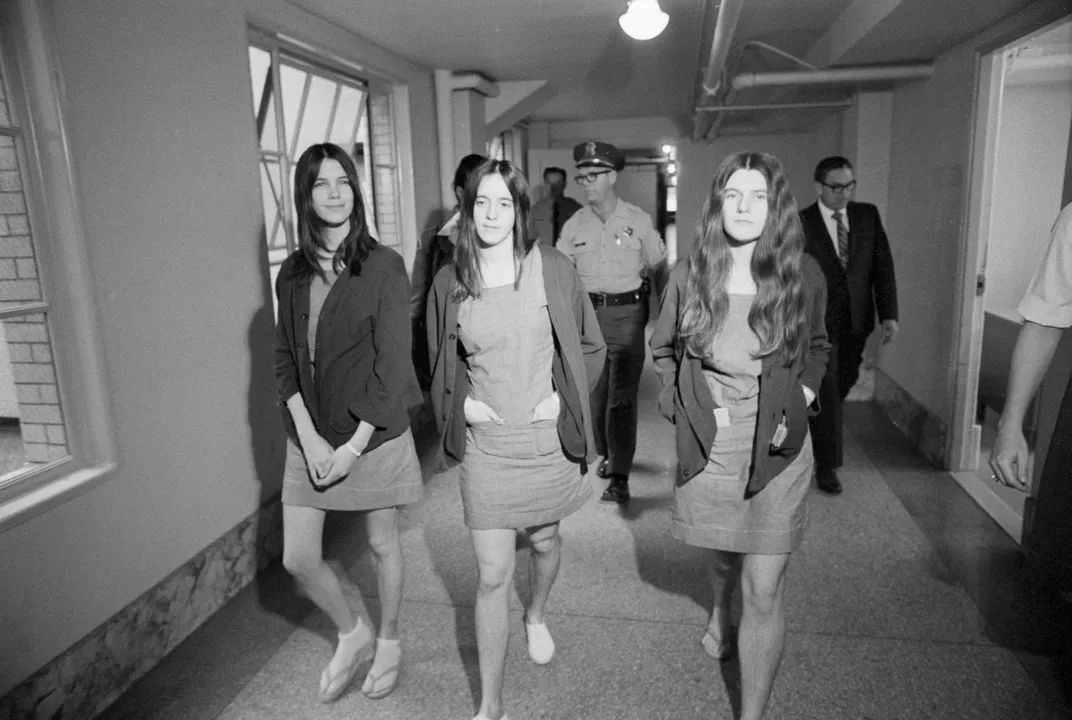
In the public'south imagination, the "Manson girls," equally they came to exist known, loomed well-nigh as large as Manson himself. Mostly young women in their late teens and early 20s, Manson Family members were, in the belatedly 1960s, not especially unusual. White, heart-class women all over the country were heading for cities like San Francisco and Los Angeles, inspired past other hippies to "turn on, tune in, and drop out." Manson used his female followers to lure other men to both bring together the group and to support it—it was several of the women that initially met Dennis Wilson and brought Manson to his dwelling.
Manson and the Family unit bounced around Los Angeles, somewhen settling at Spahn Ranch, an erstwhile film-and-telly set in the western San Fernando Valley. At Spahn, Manson exercised total domination over the group—members were reportedly forbidden from wearing eyeglasses or carrying money, and in Member of the Family unit: My Story of Charles Manson, Life Within His Cult, and the Darkness That Ended the Sixties, Manson follower Dianne Lake (just 14 when she met Manson) detailed long nights of lectures, in which Manson instructed others at the ranch to take LSD and listen to him preach almost the past, present and hereafter of humanity. Some of the Family remained loyal to Manson fifty-fifty after he was sentenced to expiry (later converted to life in prison house when the country of California overturned the use of the capital punishment)—in 1975, one of Manson'southward primeval followers, Lynette "Squeaky" Fromme, attempted to assassinate president Gerald Ford (her gun jammed and she was quickly felled by the Hole-and-corner Service).
How did Manson fit into the Hollywood scene?
Manson had connections to a number of wealthy and influential people in Los Angeles. Through Dennis Wilson, he became acquainted with record producer Terry Melcher, son of actress Doris Day and boyfriend of model and actress Candice Bergen. At one betoken, the girl of extra Angela Lansbury was a Family hanger-on, and though she wasn't an official member, she used her mother's credit cards to buy the Family's food and habiliment.
Melcher and Bergen lived at the house (10050 Cielo Drive) that Tate would eventually hire with her hubby, director Roman Polanski, and Guinn posits that the firm represented Manson's rejection past the musical establishment—he'd courted Melcher as a patron, and even hosted the producer at Spahn Ranch, where Melcher politely listened to Manson and the Family perform. Manson pinned a great deal of hope on his connections with Wilson and Melcher, and it'southward widely believed that once it became clear the two men weren't going to significantly advance his music career (though Wilson did convince the Beach Boys to re-work and record a version of Manson's vocal "Stop to Be," which they renamed "Never Learn Not to Love," information technology was considered a flop), Manson became increasingly focused on violence.
/https://tf-cmsv2-smithsonianmag-media.s3.amazonaws.com/filer/19/4b/194bcf58-79ed-46d2-831b-f9d3d0af1f36/gettyimages-1024687486.jpg)
/https://tf-cmsv2-smithsonianmag-media.s3.amazonaws.com/filer/9f/23/9f23f192-d4a1-4544-8bf2-14a908a465a0/misc_1.jpg)
What was 'Helter Skelter'?
Prosecutor Vincent Bugliosi, in his exhaustive attempt to put together a motive for the Family's killings, landed on Manson's obsession with what he called 'Helter Skelter.' Taken from the Beatles song of the same name (Manson told his followers the White Album was further evidence his theories well-nigh the end of the world were correct), 'Helter Skelter,' in Manson's circumlocution, was the pending race war that would run across thousands dieand forcefulness the Family disappear to surreptitious caves. There, they would await until it was time for them to emerge and rule what was left of the earth.
While Manson initially foretold that the outset crimes would be committed by African-Americans confronting whites, the drastic state of his affairs in the summertime of 1969—his musical aspirations had largely come to nothing and his Hollywood connections had died up—led him to shift focus and tell the Family they might have to begin Helter Skelter themselves, committing savage crimes in upscale neighborhoods in an effort to demonstrate to African-Americans how the violence should be carried out. In 1974, Bugliosi published Helter Skelter: The True Story of the Manson Murders, the kickoff major work examining the Manson Family and the all-time-selling true law-breaking volume of all time.
/https://tf-cmsv2-smithsonianmag-media.s3.amazonaws.com/filer/dc/47/dc47e4b2-2025-4b5b-ab3b-b500960a6dad/spahn_1.jpg)
Who were the Manson Family'due south victims?
On the nighttime of August viii, 1969, Manson Family unit members Tex Watson, Patricia Krenwinkel, Susan Atkins, and Linda Kasabian (who would later turn state'south witness against the others) drove to Tate and Polanski's home (the director was out of boondocks working on a film). The viii-months pregnant Tate, who appeared in 1967's Valley of the Dolls and was considered i of Hollywood's most promising up-and-comers, was relaxing at home with her friends: celebrity hairstylist Jay Sebring, coffee heiress Abigail Folger, and Folger'south boyfriend Voytek Frykowski. None of them had whatever tangible connexion to Manson or the Family other than being physically in the business firm previously occupied by someone Manson knew (Terry Melcher).
In Helter Skelter, Bugliosi writes that a witness for the prosecution described a March 1969 twenty-four hour period on which Manson came to the house looking for Melcher and found Tate on the porch instead—"There could be no question that Charles Manson saw Sharon Tate, and she him," writes Bugliosi.
Tate and her friends all died at the hands of Watson, Krenwinkel, and Atkins, as did Steven Parent, a teenaged friend of the house'south caretaker who happened to exist pulling out of the driveway as the killers arrived.
The very next dark, the same group of Family members, plus Leslie van Houten and Manson himself, set out to commit more than murders. They drove to the house of grocery business executive Leno LaBianca and his married woman, Rosemary, in the Los Feliz expanse of Los Angeles. LaBianca was totally unknown to the Manson Family—some of its members had reportedly been to a party in the neighborhood. According to Bugliosi, the LaBiancas were chosen at random afterwards several hours of driving effectually upscale Los Angeles neighborhoods.
Why does Manson still loom and so large?
The brutal nature of the murders committed by the Manson Family, in addition to the fact that some of the victims were celebrities, touched upon some of the deepest fears of the American psyche—the idea that you might non exist rubber at home, for one, and the thought that fifty-fifty 'adept girls' are a few moves away from committing unspeakable crimes. They also cemented the thought in popular civilisation that the Free Dear move of the 1960s wasn't free at all. It's a sentiment farther explored in Jeffrey Melnick's Creepy Crawling: Charles Manson and the Many Lives of America's Most Infamous Family unit , in which Melnick, professor of American studies at the University of Massachusetts, Boston, examines the long-term cultural affect of the Manson Family. In "The White Album," an essay actualization in her eponymous collection named after the Beatles anthology, Joan Didion uses the murders to argue that the '60s had effectively ended—"the paranoia," she wrote, was fulfilled.
Source: https://www.smithsonianmag.com/history/manson-family-murders-what-need-to-know-180972655/
0 Response to "Manson Family Member Speaks Out About Life Inside the Cult"
Postar um comentário